Codes and Conventions of Existing Teen Horror Films

Dead Wood

At the beginning of Dead Wood, before we even see any visuals, we are presented with the symbolic code of birdsong. Immediately, an audience associates this with peace and innocence, and are lured into a false sense of security, which is only increased by the soft, ethereal music that begins to play alongside it (note, though, that the piano plays a series of minor chords, creating a melancholy, creepy atmosphere). We are
The jumpscare and shaky camerawork
then left completely unprepared for the following jumpscare, which makes it all the more effective. As this happens, there is also a crescendo in the soundtrack, which adds to the scare and causes the audience's adrenaline to increase for the chase scene. During said scene, the camera shots are unstable. We can no longer see clearly because of it, and become disoriented, just like the protagonist himself.

In the final moments of the opening, Rob's friend is calling out to him, and a crane shot slowly pulls us out of the scene. Having the camera looking down upon the character represents how vulnerable she is, and visually shows us how isolated the rest of the woods are, emphasised by the eerie score in the background. It is also interesting to note that we are never shown who, or what, killed Rob. Presumably, this has been done to build up to a reveal later on in the film. By keeping us unaware of what the threat is, we don't know entirely what it is capable of, and creates a whole new fear of the antagonist.

There are quite a few conventions used within this opening. Immediately, we are introduced to the secluded location; this isolates the protagonists from any help, and therefore makes the threat of something chasing Rob more significant, as he must face it alone. Furthermore, the somewhat clichéd jumpscare alerts the audience, and makes sure they feel unsafe and on edge while the chase scene happens. As he flees, Rob falls victim to the convention of inexplicably falling over, and this builds up the apprehension that the protagonist is not going to make it out of his situation alive. A variant of the short cut trope appears as he tries to jump over the stream and ends up being dragged to his death-in-the-first-five-minutes; through this, the threat of the killer is established, and the audience are given the impression that escape from the antagonist is difficult, if not completely futile. Both of these inferences make viewers more afraid of what the enemy can do, which will impact the fear we feel whilst watching the rest of the movie.

Dead Mary

Dead Mary's use of codes is very interesting, as there is lots of contrast with what is typically expected of horror as a genre. Cicada sounds, which are the first sound effects we hear, suggest that this scene takes place on a summer's day - this is unusual, considering that bad weather is a convention of horror movies. However, combined with the squeaking of chains that we come to hear, the sound creates a piercing noise that is uncomfortable to listen to, and begins to build up suspense. The added tapping of the protagonist's fingers slowly bring the noise to a tense crescendo. Occasionally, it becomes distorted. Because of its ghostly sound, we can infer this to mean that something supernatural is nearby, and because the protagonist is unaware of this, the audience feel unsettled.
Camera shots are also used very cleverly, such as the close-up focusing solely on chains. This plays with our assumptions; knowing the film's genre, we connect this image with imprisonment and restraint, but in the next establishing shot, it is revealed to be a sign. Although this is anticlimactic, the conventional isolated location
The trickery of the camera work


means that the tension is not destroyed completely. The camera also keeps a selective focus on the car, which takes up a small portion of the shot, rather than street behind it. This makes us cautious that something may be lurking beyond our vision. Suspense is built by shots that seem to suggest something hiding (shots of trees, empty streets, under the car, etc.), but lead to nothing; again, an anticlimactic reveal, but the abundance of these sorts of shots seem to suggest that something isn't right in this location, even if we aren't yet being given any clues. The suspense continues to build because of this.


Conventionally, though, Dead Mary contains very little. As mentioned before, the location is secluded, and there is also no phone reception. As an audience, we then feel that the threat is so much more dangerous, as the characters are disconnected from any sort of help, and must face the looming threat on their own. There is also a minor jumpscare when the oil cans are slammed onto the ground; it breaks the tranquility of the first few minutes, and keeps the audience on their toes. Otherwise, it is not a very generic opening to a horror movie. In many places, it outright juxtaposes the film's conventions, such as the broken vehicle being fixed before any sort of threat is encountered, and positive weather. In many ways, this is a positive thing, as the audience can no longer predict how the plot will play out; we are more likely to be invested in what is happening, and the scares will be much more effective if we cannot see them coming.


Wrong Turn

Wrong Turn is very heavily influenced by codes. Sound plays a heavy part in this. From the very beginning, we hear deep, eerie bass sounds, which immediately set a sombre tone. Echoes of voices have been edited into the scenes during post-production; this emphasises the emptiness and seclusion of their location, making sure the audience understand that help is out of reach. In the visually frightening moments, there are often sudden swells of music. Examples of this occur when blood drips onto the girl's face (the first indication of her friend's death), when she discovers his dead body (the confirmation of his murder) and when she is dragged away by the antagonist (suggesting that she will meet the same fate). These musical cues punctuate each event, and mark them as significant to the story, as well as reflecting the bursts of fear that the female protagonist feels in each of these moments. In contrast, silence is frequently used to stop the action, even for a moment, and interrupt the pace. This happens twice - when the girl falls from the cliff, unaware that she has landed next to her friend's dead body, and when she trips while escaping. Both of these make the moments following them - the discovery of the body and being captured by the killer, respectively - much more poignant and effective, causing the audience to wait for the next scare and building up tension. They tease us with hints of safety, only to snatch it away when the danger kicks back in.
Visually, there are also lots of codes. Frequently, we see birds-eye views of the climbers. Similarly to the crane shot in Dead Wood, it is a visual representation of the vulnerability of the characters. On the other hand, there are also lots of worms-eye shots, or point of view shots

of the girl looking up at her friend. These have the same effect, showing the girl helplessly looking up, and adding to the sense of being weak, unsafe
The victim inexplicably falls
and fearful. During the tense, action-driven moment in which the unseen force is trying to cut the ropes holding the girl on the cliff, there are rapid transitions between shots, sometimes having four or five different shots in a single second, which increase the pace of the moment, replicating the protagonist's desperation and adrenaline. This effect is even stronger during the chase scenes, in which, for a second time, the camera is unstable.

This film is very similar to Dead Wood in its conventions, and the intentions behind having them. Like all of the openings so far, the location is secluded to prevent the protagonists from being saved. This setting, on the side of a cliff, is also very dangerous, which adds to the threat when the antagonist arrives. There is a fake scare when the girl nearly falls; this forewarns the audience to the danger that this protagonist will be in when she is inevitably hunted down. The victim inexplicably falls whilst fleeing to her vehicle (which she never reaches, so it is unclear whether she would have adhered to the car-won't-start convention), and is inevitably the second death in the film's first five minutes. Like Dead Wood, this is done to generate fear for the protagonist, and present the antagonist as inescapable.

A screenshot of the notes used to write this essay


Research: The Importance of Opening Titles

Opening titles are the sequences created at the beginning of a film or TV show to introduce the production, and give necessary credits to the people involved in creating it. Additionally, their purpose is to give the audience a taste of what is to come. Codes such as music and sound effects are often used to set the tone, and sometimes foreshadow the events within the film/show.

The conventions of an opening sequence include:
  • Distribution and production company - if the audience enjoys the film they see, they will refer to other works created or distributed by these companies, thus why their names appear in the opening credits
  • Cast - usually, the top billing actors are listed first in order to catch the audience's attention quickly; sometimes, one actor can attract an audience member to see a film
  • Director(s)
  • Title of the show/film - this is usually a heavy implication as to what the film is going to be about; for instance, Friday the 13th already has horror connotations due to the superstition surrounding the date
  • Executive producer(s)
Left to right: distribution company, cast, title, executive producers, directors, production company (click here for the website used as a reference)

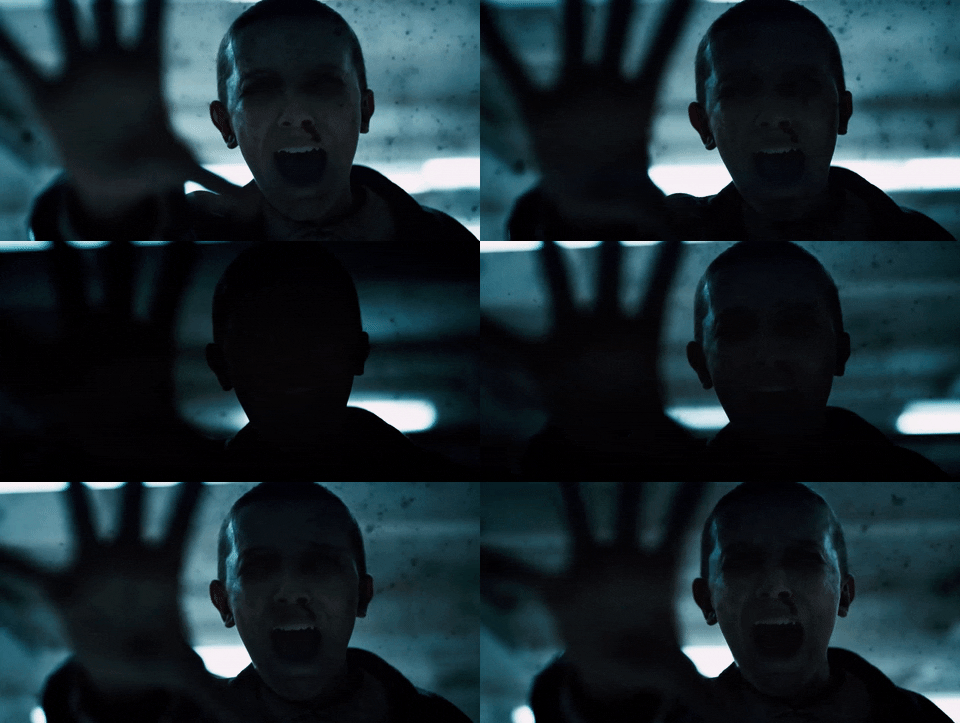
Stranger Things

Below is the intro to the Netflix series Stranger Things. It is relatively minimalist, as far as opening titles go. However, it contains some of the conventions we would expect to see in a title; the production company, the actors' names, the executive and co-executive producers, and the name of the show. It is also a good example of using codes to create an atmosphere. The show fits comfortably into the genres of horror, mystery and drama, and the opening title presents this. Symbolic codes such as the black background (implying darkness) and red text (having connotations with blood and danger) suggest that the show is going to be frightening. The low, repetitive, mechanical-sounding music also creates intrigue and discomfort. These help the audience to infer the mood and genre of what they are about to watch.


Both technical and symbolic codes can affect how an audience interprets the rest of the film from the opening title. These include:
  • Typography - how the text is presented can give clues to the setting or the genre
  • Colour palette - the colours used often set the tone of the show/film
  • Imagery - how video footage, still images, animation, etc. are used can give viewers an idea of the target demographic for the show/film
  • Editing and Camera Movement - these can affect the sense of pace in an opening title
  • Lighting - how dark or light an opening is can build or detract tension
  • Music - theme tunes and soundtracks can tell an audience a lot about a film; where it's set, what genre it is, and even the exact film itself, if the music becomes iconic enough
Often, the combinations of all of these aspects become very artistic and intriguing. Audiences cannot lose interest through the credits, otherwise they will stop watching. However, as easy as it may seem to make an interesting title, careful choices have to be made about its contents; for instance, colours are very important - not only in creating aesthetically pleasing visuals, but to make sure that the text is always legible, and doesn't get lost in the background. After all, the primary function of a title is to give credit to the people collaborating in the film or show.
Opening sequences never give away plot points! Although they can hint and foreshadow, they never spoil what is to come later. Instead, they are only meant to drop clues, and not necessarily about the plot. They can be used to establish location, time period, characters, or even just the general atmosphere. Spoiling the narrative would give an audience no reason to continue watching, and would make the rest of the show/film pointless.


Conventions in Horror Films

Conventions are the expected features (in terms of plot, character, etc.) that can be found in a particular film. Below are the standard conventions that can be found in teen horror films.

Creating the Threat

Immediate Death - The Gallows
Someone is Killed in the First Five Minutes - this is usually an unnamed or minor character, and is used to establish the threat of the antagonist
X Years Before / Later - flashbacks or flash forwards are used to transition into the main plot after foreshadowing the audience

Building the Danger...

Secluded Location - the protagonists are isolated, and given no means of finding help when the 
antagonist finds them
Secluded Location - Cabin in the Woods
Power is Cut - the characters are left with no electricity, which usually acts as an initial sign of danger; this links in with the No Signal or, for older films, the Phone Line Cut tropes to cut off the characters from any form of communication
Bad Weather - the use of pathetic fallacy to create an inference of danger; usually comes in the form of a nighttime setting, rain or a storm 
The Fake Scare - tension is built, leading to an anticlimactic jumpscare; sometimes it is followed by a real scare 

A Series of Unfortunate Decisions

Characters Forget About Threat - they disregard/are oblivious to danger
Warning Goes Unheeded - obvious signs of danger (eg. DO NOT ENTER signs or local legends) ignored
The Short Cut - a shorter route is taken to the destination, leading the characters into danger 
Someone Investigates a Strange Noise - goes against all logic, and involves a character pursuing a noise that the audience know leads to a threat
Victim Cowering in Front of Window / Door - allows for dramatic shots (eg. a shattering window), but is not a sensible decision for the character
Someone Runs Upstairs Instead of Outside - does what it says on the tin, and is always an irrational decision
Victim Inexplicably Falls Over - gives the antagonist an opportunity to catch up with the protagonist, and builds tension
Vehicle Won't Start - sometimes linked with the Forgot The Keys trope; the protagonist cannot start their vehicle, which is the only fast means of escape from the protagonist 


Above is the opening scene of the slasher film Friday the 13th. I watched through this scene and identified some of the conventions that were used, as well as the effects they had on me as an audience member.

- Bad weather; the night-time setting immediately set the tone for the opening. It felt very ominous, as it would be difficult to see any threats hiding in the darkness, which the point of view shots (see below) and the music cues seemed to hint at.

- Isolated setting; with the impending danger that was being built up, the fact that the characters were so far away from any help made the scene more intense and scary. They were oblivious to the danger, but as an audience member, I was not; watching the killer creep up on them when they had no idea of what was happening built tension, as I was unable to control or stop the death that I knew was coming.

- Death in first five minutes; this helped to establish how dangerous the killer was, and therefore made the threat in the rest of the movie more real.

- Killer's point of view shot; as mentioned before, this gave me a sense of being completely immobile. I could see where the killer was going, and I could infer by the music cues that they were going to be dangerous, but I had no control over the situation, making me feel scared and powerless.


Preliminary Task: Editing and Evaluation

Below is the final edit of my group's preliminary task, and an evaluation of the final product.


Our task was to create a short film consisting of at least twelve shots, showing technical skill through the use of camera shots, angles and movements, as well as match on action, shot/reverse shot and awareness of the 180-degree rule. It had to involve a character walking through a door, entering a room, sitting down and exchanging dialogue with another character.

To prepare for this, we mindmapped ideas for a basic narrative, and eventually settled on the idea of a secret agent informing a colleague that a mission had failed. We then created a basic storyboard for each shot, planning out what each one would look like, and how/where it would be filmed, ensuring that we had a pre-prepared reference to get the filming done as efficiently as possible on the day. Then we planned everything relating to mise-en-scène, including a cast, a filming schedule, location planning and a shot list; this gave us a definite plan when it came to filming, and ensured that we had everything we needed in advance.

Generally, filming went well, and most of the shots we needed were effectively filmed. We had to improvise with some of the props that we couldn't get our hands on (for instance, we were looking for a brown folder, but had to use blue when we couldn't find one fitting the description before the day of filming). Although we almost ran out of time to use our location, we managed to film everything within our time limit. Because the person we cast for Agent A did not attend on the day of filming, we had Ashley step in to play Agent A, and called in a friend, Josh, to fill in for Agent B. We also had to leave out the establishing shot we planned as our first shot, as illness and other commitments meant that none of our group were free to film at the designated time, or at any point before our given deadline.

Post-production editing was important because it allowed us to put the filmed scenes in the correct order, and blend them together into one piece. For instance, we filmed Agent A entering the room, we had a match-on-action of his feet walking through the door; editing allowed us to seamlessly have the long shot transition into the close-up without suspending the audience's disbelief. However, we had to cut some of the shots to a shorter length than we would have liked due to continuity errors in the actors and props.

I think our film's strengths lie in the variety of camera shots and angles that we used, and our awareness of the 180 degree rule. The shots we chose are all appropriate for what is happening in the scene, making sure all of the action happens on screen, and the angles suitably set the tone of the piece - for instance, the close up on Agent A's eyes as he starts to get angry is effective in building suspense. Our use of the 180 degree rule means that the perspective is never broken, and the audience always believe what they see. A weakness in our piece would be a lack of continuity, both in the lighting (which, as it was natural light, was beyond our control) and prop/actor positioning. When we film our main task, an area of development would be to make sure all of our shots are consistent. Editing helped us to cover most of them, but we were unable to fix some, such as when the folder would close and open between shots, or when the actors' positions were not exactly the same as they had been previously. We also need to make sure we leave plenty of time to reschedule filming, as we were too close to the deadline to find more time when our schedules didn't go to plan, and make sure everyone in our cast is clear on when the filming will take place. Additionally, we should be aware of how long we have to use a certain location whilst filming, so that we can properly structure a time frame for recording each shot and don't have to rush anything.

Preliminary Task: Filming

Our task was predominantly a team effort in all areas. All three members of our group contributed with directing and camera work (although Wik played the main role in these, as the narrative was her idea, and she is the most experienced with camera equipment). We all had a say in, and came to an agreement about the location in which we filmed, and the areas in said location that our scenes would take place in. Casting was also a mutual decision, including our last minute addition (see below).

One problem with our filming process was that a member of our cast did not turn up on the day of filming. I solved this problem by calling in another person, Josh, to take his place. Until he arrived, I took his place in scenes in which he would not be visible, eg. in sliding the folder towards Ashley during a scene in which my hand would not be visible. We also could not get our hands on a brown folder as originally planned, but I brought in a blue folder, and a spare piece of paper to make the 'FAILED' sign, making up for our missing props. Furthermore, we did not check how long the location would be available during pre-production. This meant that we nearly ran out of time to use the space.

For future reference, we will make sure that all our cast members are very clear on the filming schedule, and double check that they are the most reliable people to use - and if not, that we have a backup cast member readily available. We will also ensure that we are clear on the closing times of our scheduled location so that we can get our filming done in plenty of time.